Edward Scissorhands: a modern-day fairytale and ode to the outsider
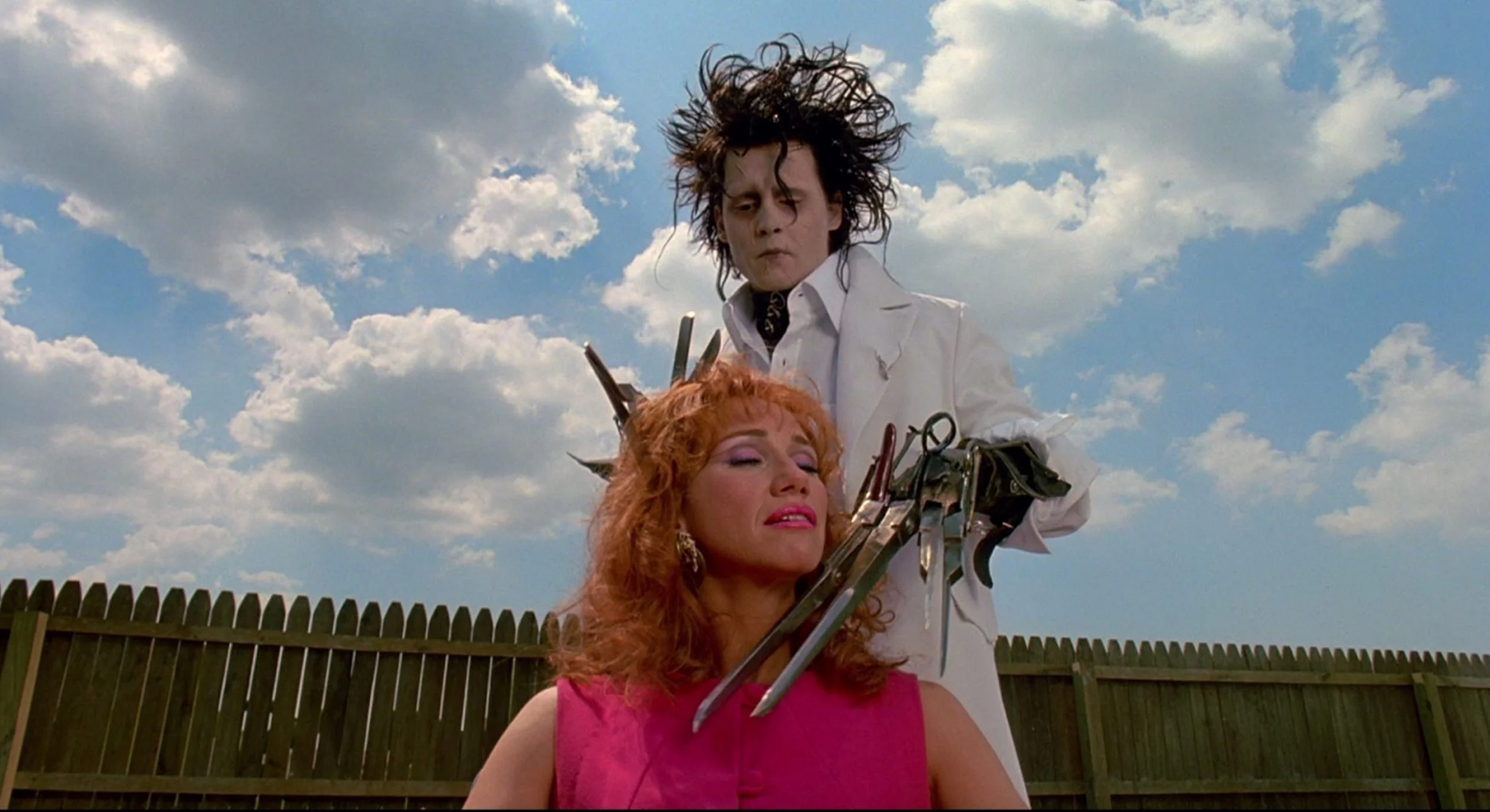
Johnny Depp in Edward Scissorhands. (Photo: 20th Century Fox)
by Angel Lloyd
@angel_georgia_mae
Last December I went to see Matthew Bourne’s enchanting ballet, Edward Scissorhands at Sadler's Wells in London. I’d seen the same production over fifteen years ago when I was seven at Newcastle’s Theatre Royal; it was a truly moving experience to see it again and proved just as magical and innovative as I remembered.
Based on Tim Burton’s beloved 1990 film, written by Caroline Thompson (who also adapted the story for Bourne’s stage version), Edward Scissorhands is a tale about a sweet Avon lady who, upon venturing into an abandoned gothic mansion, encounters an artificial young man who has scissors for hands. Hoping to take care of him, she brings him back to her small suburban town which lies just at the foot of the mansion. Edward is accepted by the community who are, at first, beguiled by his unique abilities but then gradually, as the tide begins to turn, is ultimately ostracised by them.
It’s a familiar fable about society’s conflicting attitude towards outsiders, ‘as much as people are enchanted by otherness, they’re also terrified of it’ (Caroline Thompson, 2020). It’s a core theme that tauntingly underlies the stories we love most and is subsequently explored in Edward Scissorhands, a modern day fairy-tale that presents us with a world that is heightened yet hardly dissimilar from our own…
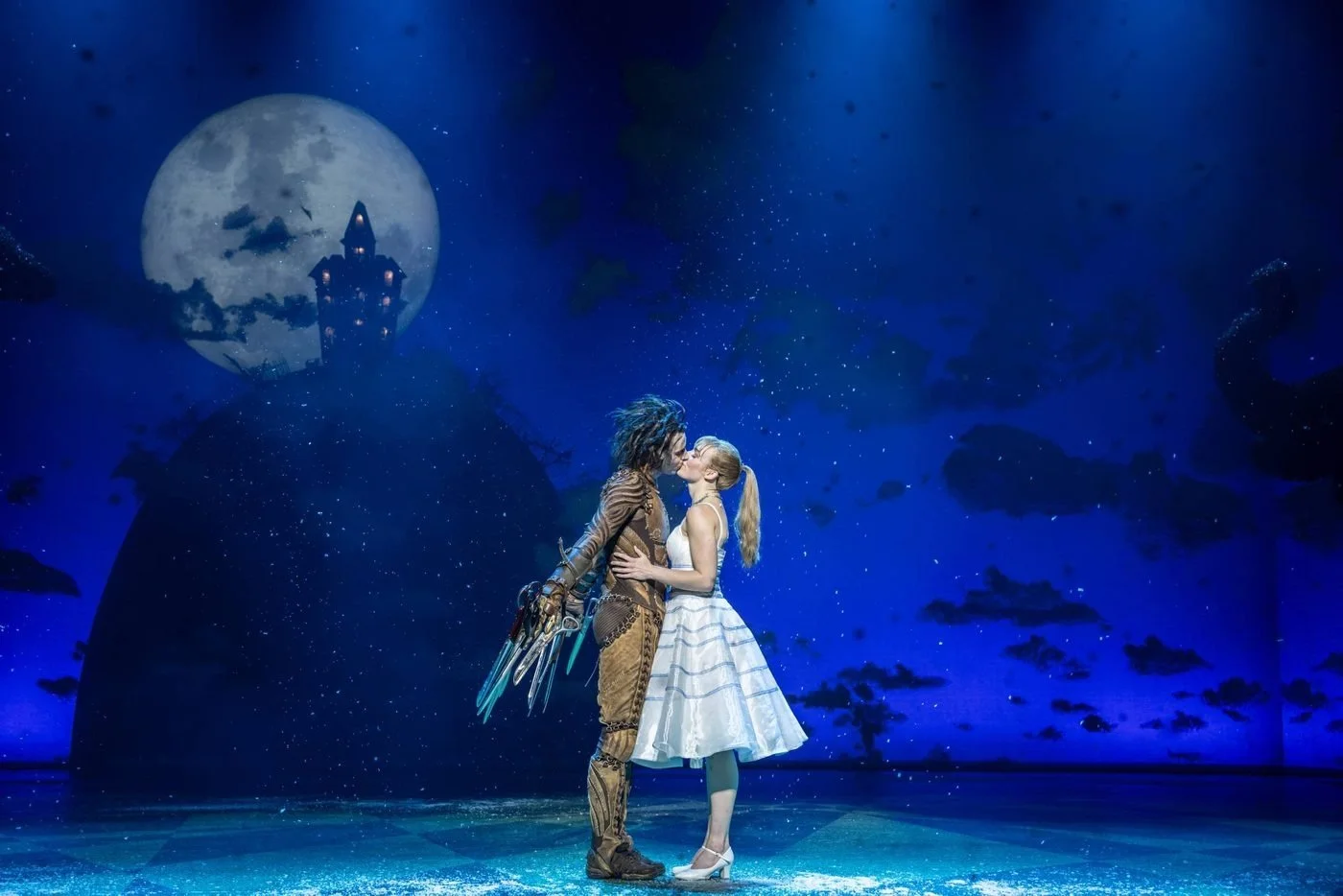
Edward Scissorhands - Matthew Bourne's New Adventures (Photo: Johan Persson)
In fairy-tales, objects often possess magical qualities that externalise the innate themes of the story, whether that be a glass slipper, a giant beanstalk or in this case, scissors for hands which signify a heartbreaking inability to connect. Edward is a sweet-natured soul who contrasts against his somewhat startling persona and in this contradiction lies the universal appeal of the story. Both relatable and other worldly, this duality urges us to see Edward as a familiar fairy tale character with magical skills; crafting whimsical topiary, ice sculptures and wacky hairstyles for neighbours and dogs alike. These talents initially draw people to him, yet when the spell is broken and the reality of his experience has negative (though unintentional) consequences, this causes people to reject and isolate him, emphasising the idea that outsiders are often treated as spectacles.
There have been many comparisons between Edward Scissorhands and classic fairy tales & literature, namely, Gabrielle-Suzanne Barbot’s Beauty & the Beast and Mary Shelley’s Frankenstein which Thompson drew on as primary source material. In both these tales, beauty is used to define and segregate people into the ‘accepted’ and the ‘unacceptable’. Peg Boggs, the kind Avon lady who welcomes Edward into her home, takes on a fairy-godmother role as she gives him new clothes and applies various lotions and potions to his skin, trying to heal the scars on his face; Thompson here also paying homage to Cinderella. Peg knows they exist in a society in which, similar to most fairy tales, ‘beauty equals goodness’ and in so doing, is trying to help him assimilate into a world that is quick to mistrust anyone different.
It’s a story of extreme visual contrasts which amplify the pain of being misunderstood, such as when we first meet Edward; he appears in menacing silhouette to a terrified Peg, but as she starts to flee, he emerges helplessly from the shadows, pleading to her in a child-like voice, “Don’t go”. This idea even filters into the set design, such as when Peg first ventures beyond the mansion’s imposing gothic facade and into an enchanting garden, bejewelled with bright flowers and ornate topiary deer and sea creatures, echoing Belle’s discovery of the Beast’s opulent library in Beauty & the Beast; beyond the dark brick and bramble lurks an intimate, tender beauty that epitomises Edward’s struggle in that his appearance and the subsequent way people perceive him doesn’t align with who he truly is, thus hindering his ability to express himself and connect with others.
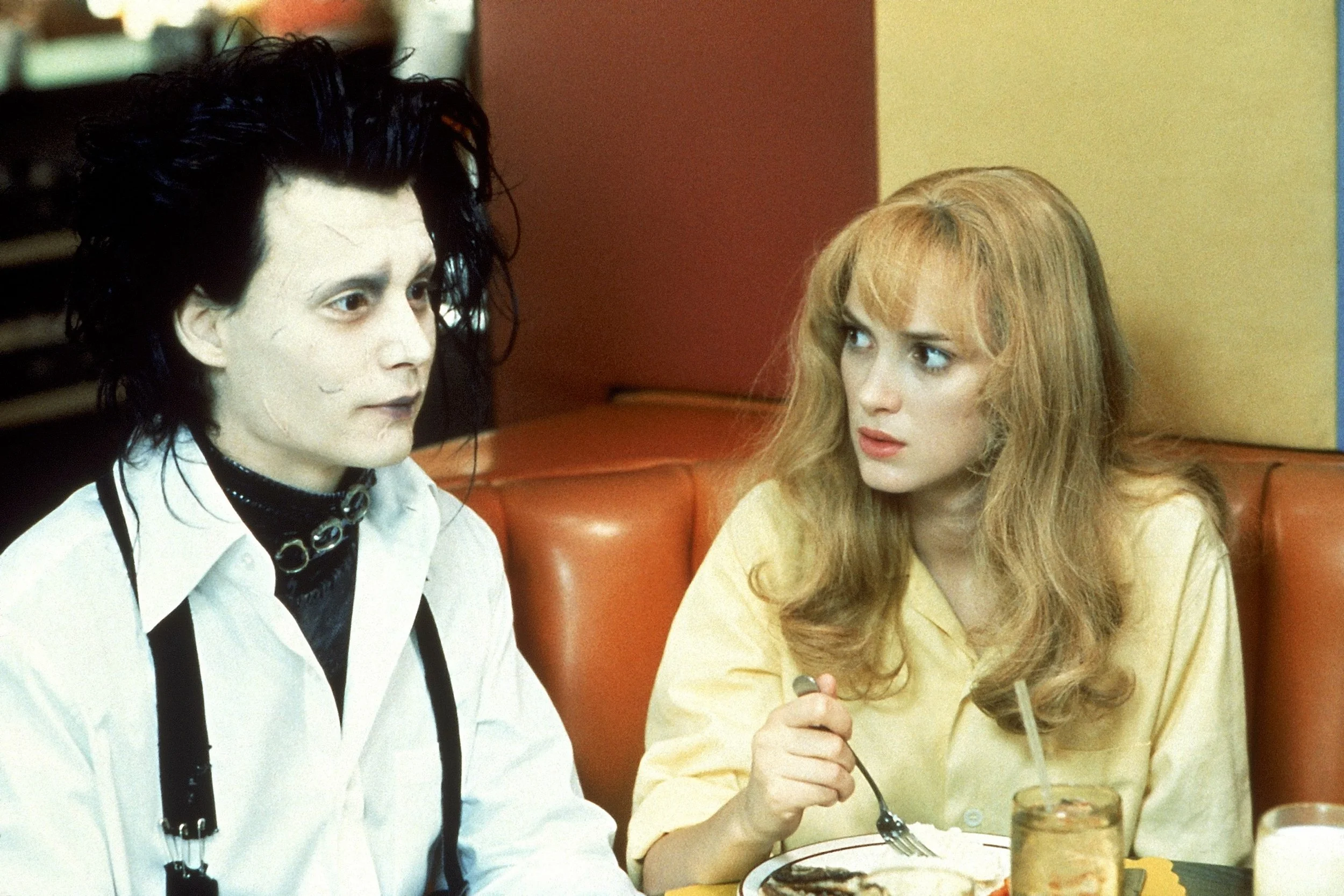
Johnny Depp and Winona Ryder in Edward Scissorhands. (Photo: 20th Century Fox)
At the heart of the film, the love story between Edward and Kim is, on the surface, very reminiscent of the romance in Beauty & the Beast, yet is also deeply profound. Edward falls in-love with Kim in a pure, innocent way when he sees her picture for the first time; she’s beautiful and angelic and in essence, everything he wants to be. Kim is initially the ‘Proud Beauty’ fairy-tale archetype transformed into the unattainable ‘popular girl’ at school, however she gradually falls for Edward and in so doing perhaps expresses the truest form of love in the film. The neighbours are infatuated with him, treating Edward like a shiny new toy and Peg, while being maternally loving towards Edward, seeks to protect and look out for him, whereas Kim is arguably the only person to love him as an equal. It’s not even necessarily a romantic love, but a meeting of kindred spirits as Kim truly sees Edward, which is what he desires most; to not just be tolerated but understood. It’s a very young love, the kind you only ever experience once, and is therefore very touching because of this; you know innately it cannot last, yet the impact it has on them both lingers in the bedtime story Kim tells her granddaughter and the snow Edward creates in the process of carving ice sculptures, solely to let Kim know he’s still there, having never forgotten her.
Thompson also employs the darker fairy tale trope of the mob hunting down the outsider which appears in both Beauty & the Beast and Frankenstein. By the film’s final act, the neighbours turn against Edward after they mistakenly believe he has robbed someone’s home and also attacked Kevin, Kim’s little brother. They’re quick to assume the worst in him, emphasising how their initial love towards him was facile, conditional and always on their terms. Subsequently, they chase him from the town and back to the mansion on the hill where he originally came from. This ultimately serves as a reminder that we have evolved very little and that the mob still exists, except rather than a rural fairy-tale village, it’s now modern-day suburbia.
There are also nods to other tales such as The Sorcerer’s Apprentice which is paid homage to through the enigmatic Inventor, a modern-day wizard (Edward’s ‘father’), who gleefully watches as his strange and flourishing contraptions bake cookies for him in his lab. Like workers on a factory line, he has given them human qualities; the bolts and flashing lights giving the impression of eyes, their cookie-cutter feet dancing on the dough, encouraging us to see their is magic everywhere, even in machinery. There is also a subtle hint of Alice in Wonderland underlying the film, as we essentially watch Edward, like Alice, venture into the unknown and encounter a host of distinct characters who are all exaggerated forms of people we might recognise in our own lives. We’re experiencing the story through Edward’s eyes so there is a plastic vibrancy to the suburban town where everything is cartoonishly heightened, from the colourful pastel houses to the outlandish clothing which contrasts so starkly to Edward’s gothic, leather-clad body-suit and fabulous Robert Smith hair. Ultimately this emphasises the loneliness people deemed as outsiders can feel within communities and the internal conflict this causes, particularly when we’re taught these places should feel like home.
In an interview she did on the podcast Script Apart in 2020, Thompson also details the influence Peter Pan had on her. Reflecting on the 1954 filmed stage version of Peter Pan she used to watch as a child, she emphasises how tragic she found the book-end structure which opens with an elderly woman telling the story of Peter Pan to her granddaughter, only to reveal at the end that the elderly woman is Wendy, lovingly reflecting on her past adventures with Peter. Wendy states that she wishes for Peter to remember her as a young girl and we see Thompson replicate this very closely in her structuring of Edward Scissorhands with older Kim fondly recounting Edward’s story and, echoing Wendy’s sentiment, explaining to her own granddaughter at the end of the film why she doesn’t go to visit Edward; “I’m an old woman now… I would rather him remember me the way I was”. This plaintively frames Edward as a Peter Pan figure, an ageless character that transcends into a folkloric myth, yet his presence is felt deeply in the snow he gifts the town; a gentle reminder of his contribution to their world. There are also other tributes paid to Peter Pan in the film, such as in Danny Elfman’s exquisite score; at one point we hear a pan flute as Peg curiously looks over the small bed Edward has tried to make for himself in the empty fireplace, signalling to the audience that we shouldn’t be scared of the man we’re about to encounter…
In its exploration of social isolation and longing to be understood, Edward Scissorhands is also a story about losing your innocence; at first, Edward is open to the world and we watch as this is slowly taken away from him and it’s heartbreaking because we know, as we grow up, we never quite get that back. However, it’s more than just a fable about feeling like you don’t belong, it also urges us to be quietly triumphant in the acceptance of this fact; that we should be encouraged to celebrate our individuality. Therefore, perhaps the most moving thing about the story is that Edward is never ‘fixed’ by being given human hands, as Thompson explains; ‘it would be denying his identity if I were to take away his differences (…) I felt it was important not to disrespect him by making him like everyone else’. Moreover, the film’s thirty year legacy lives on in Matthew Bourne’s beautiful ballet, proving, like all great fairy tales, its ability to shape-shift across mediums and throughout time, as we will always be able see something of ourselves in Edward Scissorhands.
Matthew Bourne’s Edward Scissorhands is currently touring the UK. Click here for more information.