Every Generation Has Its Own Little Women
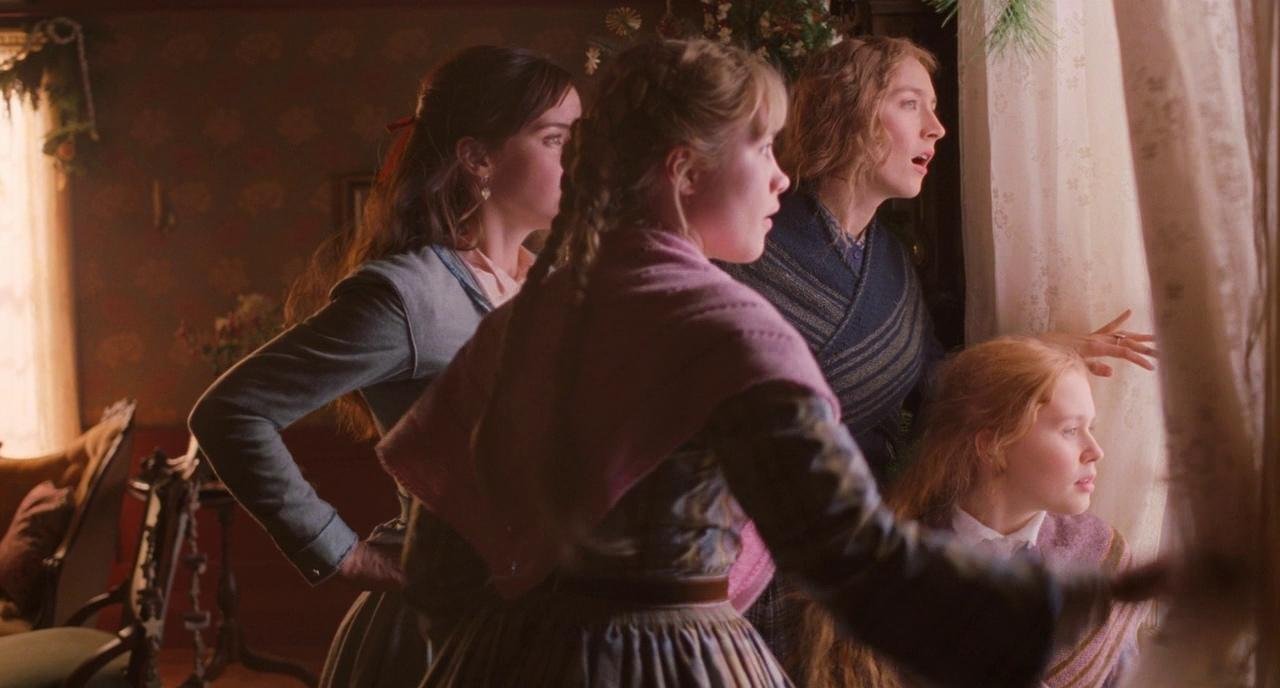
Little Women (2019) Photograph by Wilson Webb
by Holly Janem
@holly.janem
Since the birth of classic literature, the art of storytelling has evolved into an array of formats. Readers have journeyed into brand new worlds interwoven with undertones of personal experience and societal expectation, and how we share these things has been re-modernised over and over again. Yet, there is one particular story that has had a long-standing place on our shelves for almost 200 years — and it’s only getting more relevant.
In 1868, a story of four sisters hit bookshops and captivated readers. Little Women was Louisa May Alcott’s first novel under her own name, and it was an immediate hit. It follows the lives of the March sisters - Jo, Beth, Meg and Amy - who are coming of age parallel to the American Civil War. Since its original publication, the book has inspired four major film adaptations, multiple TV shows, radio plays and a Broadway musical. In the current era of mass consumption - and with thousands of new stories available to us - what exactly lies between the pages of this beloved classic that has us returning to keep turning them over?
When writer and director Greta Gerwig released her version of Little Women on Christmas Day 2019, audiences hadn’t seen the story at such scale since 1994. As the 2010s drew to a close, trinkets of nostalgia from the 90s were more prevalent in our lives than they had been since the millennium. The growing demand for anything that reverted us closer to that time could’ve been an obvious reason for another remake, but our most recent visit to 1860s Massachusetts was more than just a sentimental cash-grab, or a carbon copy of the March sisters of the past. It was a period piece that both hid and highlighted so many of our modern-day struggles within it - but a similar statement could also be made for every adaptation that preceded this one.
In most retellings, Laurie’s character is used as a driving force to represent things Jo cannot access. Firstly, he is metaphorical of an economic class that is just out of reach for her, but one which she desires: he can travel to Europe to indulge in arts and culture whenever he feels like it, rather than relying on a trip with Aunt March as she does. This theme was most heavily explored in the 1933 film which was catered towards an audience still reeling from the effects of the Wall Street Crash in 1929. When Mason and Heerman - who wrote both the 1933 and the 1949 screenplays - revisited the material sixteen years later, Laurie embodies roles that Jo cannot access because of her gender. Jo longs to run away and join the army, which is exactly what Laurie does. “I’m dying to go and fight by father’s side but here I am, sitting and knitting.” Since the last time audiences had engaged with Jo and Laurie, World War 2 had taken place, causing the military themes to be a lot stronger to coincide with fresh memories of battle and patriotic importance, paired with a deeper understanding of mobilisation for a major war and how it affected the home front. The economic message had therefore heavily shifted, just as women’s place in society had; they had been part of the workforce during the war but with the return of their husbands this was quickly disbanded. In the early 1950s, many employers were still operating a ‘Marriage Bar’ whereby married women weren’t permitted to work in certain occupations or were forced to leave their jobs upon getting married. The overarching societal belief was that a woman’s proper calling was to be a wife and a mother.
Marriage has always been a vital part of the Little Women plot since Alcott first introduced the world to the March family almost two centuries ago. In every pre-Gerwig version, the sister’s storylines led peripherally to their marriage which provides a satisfactory end, similar to that of a fairytale: all previous individualised experiences are traded in for a happy life with a loving husband. In 1949, Jo’s empowering desperation to fight like the men was still overshadowed by her engagement which was framed as the most climatic event of her life. This was not something Louisa May Alcott wanted, once telling a friend that she “didn’t dare refuse and out of perversity made a funny match for her” after experiencing pressure from publishers to have Jo married by the end of the series. Creative control has historically been an area where women have experienced adversity, as they continue to do so in today’s world.
Winona Ryder’s 1994 portrayal is much closer to that of Saoirse Ronan’s in 2019 - Jo is more creative and less bothered about being married. Marriage is still a foreboding presence around all of the girls in the 2019 version, but Gerwig cleverly and subtly includes contemporary themes that are noticeable without tampering with the original source material. During Amy’s conversation with Laurie about the necessity of marriage, she states “As a woman there is no way for me to make my own money (…) so don’t sit there and tell me that marriage isn’t an economic proposition, because it is.” A speech which has an acute self-awareness of the societal norms of the time whilst also being able to ring true with modern audiences. But these aren’t themes that Greta Gerwig created and embellished her rewrite with - these are things that have always been a part of the story. Robin Swicord, screenwriter of the 1994 adaptation, was quoted saying “Alcott put these things between the lines of the book because if they’d have been openly addressed, she probably wouldn’t have been able to get it published.”
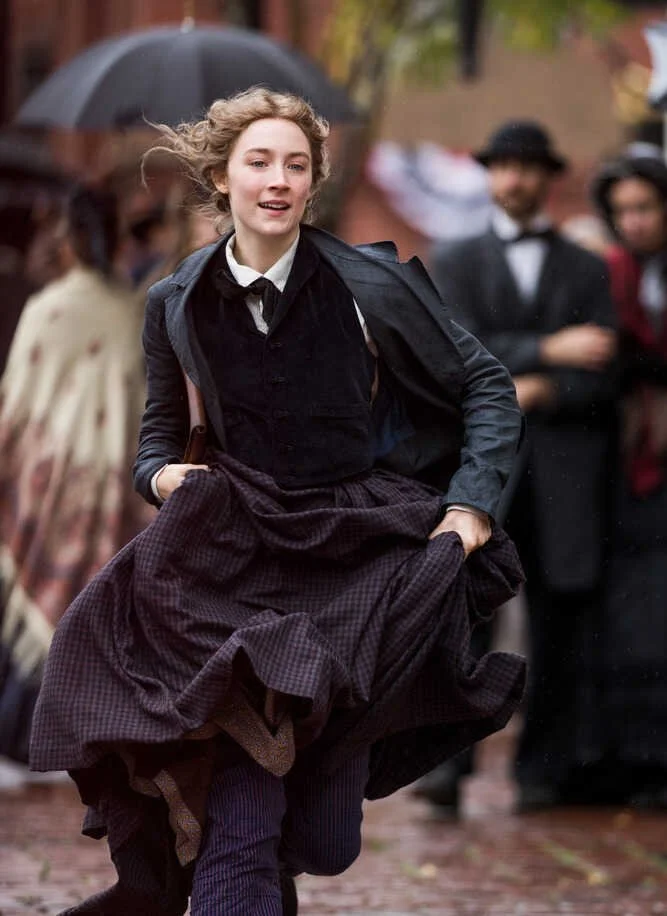
Saoirse Ronan as Jo March
Photograph by Wilson Webb
The most recent adaptation stands out most by its non-linear story structure; where the audience isn’t waiting for the traditional reveal of who each sister will marry, instead they can concentrate on the sisters’ lives and their struggles. The ending extends past what we have seen before, showing Jo getting her book made. According to Gerwig, these choices intended to ‘reverse-engineer’ the ending so that “the audience felt the same way as when the heroine is chosen by the hero.” Therefore, in a world where the average age of women settling down is higher than ever, this focus on career and nonchalance for romance in Jo March’s life coincides far more with that of modern women than it ever has before. Instead of themes alluding to war or economic crisis, the place modern audiences took most relatability from was that of an equality-based subtext. The late 2010s were a pivotal time for the role women play in creative industries; in the aftermath of the Harvey Weinstein trial, movements such as #MeToo and Time’s Up, and the recent birth of Fourth Wave Feminism, women’s voices were getting the volume turned up on them slightly - and in the case of Little Women, cinema was reflecting these notions in an already familiar fictional context.
However, the recent liberation of women’s voices isn’t without its downfalls. Having a strong voice as a woman is unfortunately still punished, but in much subtler ways. It can be read that this is potentially the vessel that Laurie is used for in the most recent adaptation; if Jo March lived in the modern world of online dating and Joe Rogan podcasts she would likely still be being scrutinised for her brash personality and big ambitions. It’s unfortunately still deeply ingrained within us as a society that a woman’s worth is categorised by how desirable she is to men, so the least she can do is be digestible and passive for them. Many men would find Jo intimidating and a potential threat to their masculinity, so as a result she may not have married at all. In the scene where Marmie asks Jo if she truly loves Laurie, she says “I think I care more to be loved (…) I’m just so lonely.” There is a huge focus within her revised storyline on compromising the comfort of companionship in exchange for greatness. Although she gets married, it’s not to Laurie, and it has been debated since publication that many believe he is her true soulmate. Arguably over time, many men have married for emotional convenience - to feel secure and to have a wife step in as the role of a mother during adulthood. So, whilst Jo deals with the confusion of wanting to be loved more than loving, Laurie goes on to fulfil his own emotional desires by marrying Amy. This can adhere to the ‘cab light theory’: coined in a 2000 episode of Sex & The City, this is the idea that a man decides when he is ready to settle down, and then does so with the next woman to arrive romantically in his life whether they are a good fit or not. Soulmates or not, in the case of Jo and Laurie she is too late.
As a contrasting character to Jo, Amy offers us a view into what Jo’s alternative could have been - marry Laurie, have his children and become a housewife instead of chasing her dream of a career. In Gerwig’s retelling, Amy is humanised - the most likeable she has ever been - and she is aware of her choices, written with a nuance that allows us to see that although she is journeying down a more comfortable path than her sister, she is choosing to do so with a sometimes painful self-awareness. We see this most prevalently when Amy says to Laurie “I won’t be the one you settle for just because you cannot have her.” The difference between the two sisters and their love lives is that Jo eventually gets both the husband and the career, teaching young women along the way that this outcome is difficult, but certainly not impossible.
So, is there actually anything wrong with a woman not prioritising marriage - both today and 200 years ago? After all, Louisa May Alcott never married and built a fortune from her novels, which are still loved today. She was famously quoted to have said “I’d rather be a free spinster and paddle my own canoe.” (a line which Gerwig wrote into her screenplay, openly sharing that she researched Alcott to influence Ronan’s characterisation.) She was the first woman to register to vote in Massachusetts, and she is survived by her determination to get women’s voices heard alongside the other cacophonous noises of the world. So with Alcott’s legacy still as strong as it was in 1868, and the lives of Jo and her sisters still fascinating women of all ages, it makes you wonder - if we see the March sisters again, what else will we learn from their story? And will we continue telling it for generations to come?
“Women have minds and they have souls as well as just hearts.
They’ve got ambition and they’ve got talent as well as just beauty.
I am so sick of people saying love is all a woman is fit for.”
—Louisa May Alcott
Little Women