Oscar’s Statuettes and ‘Snubs’: Redefining Wins In Hollywood

Margot Robbie in Barbie. Photograph by Jaap Buitendijk/Warner Bros.
by Jordy Butler
@jordybtlr
Margot Robbie, actress and producer of Greta Gerwig's Barbie, was notably excluded from the Best Actress category in this year's Oscar nominations, prompting discussions among film journalists about the industry's recognition choices.
The film's rapid ascent to becoming the highest-grossing debut for a production both written and directed by a woman sparked widespread discourse overnight. Opinions surrounding the oversight of Margot Robbie's performance in Barbie flooded social media platforms, prompting numerous film journalists and online outlets to contribute their perspectives to the ongoing debate.
Barbie received a staggering 8 Oscar nominations on the morning of Tuesday 23rd January including several key nominations including but not limited to: Best Picture, Best Adapted Screenplay, Best Production Design and Best Costume Design.
Lily Gladstone, who portrays Mollie Burkhart in Scorsese’s Killers of the Flower Moon adapted from David Grann's non-fiction novel of the same name, has received global acclaim for her performance in the role. Gladstone’s performance greatly contributes to the gruelling and potent story of abhorrent organised crime, systemic homicide and colonial transgression that took place in the Osage Indian Nation during the 1920’s.
Whilst Gladstone's achievement is significant and one that should be celebrated, recent attention in the 2024 awards season seems to pivot towards the seemingly unexpected absence of Margot Robbie.
A surge of social media users rallied in defence of Margot Robbie upon the release of this year's finalised lists asserting that she had been unjustly 'snubbed' in the 2024 Oscar nominations. The dispute emerged following the extraordinary success of Greta Gerwig's third directorial venture, Barbie, which amassed an astounding $1.4 billion at the global Box Office. Notably, this achievement positioned Barbie as the second film of 2023 to join the exclusive $1 billion club, along with Super Mario Bros.
So what does it mean to be snubbed at an awards ceremony?
The act of ‘snubbing’ at an awards ceremony is usually labelled as the event of a piece of work or a particular person that failed to be acknowledged for an award. Whilst the act of a ‘snub’ is generally up for debate, it stems from our beliefs as consumers that actors who have poured their hearts and souls into roles are losing them due to an inflation of commercial projects or perhaps losing to a specific person who we do not deem to be worthy of this award. But again, a snub is subjective based on personal preference and opinion.
The ongoing conversation surrounding Robbie's omission from the Oscar nominations has underscored the nuanced discussions within the industry about recognising achievements. Particularly against the backdrop of groundbreaking accomplishments such as Barbie's unprecedented success under Gerwig's directorial helm as well as the long overdue recognition of minority groups such as Native American, Lily Gladstone. As the narrative unfolds, the intersection of commercial triumphs and award recognition continues to be a focal point of scrutiny and analysis within the cinematic landscape.
The reception of Greta Gerwig's Barbie has been diverse. Supporters on social media commend the film for translating complex adult themes surrounding womanhood into a digestible and colourful landscape, offering a lens for the younger generation to engage with social issues that are also readily available to them.
Others possessing a contrasting viewpoint claim that Barbie’s approach to feminism is 'the bare minimum,' asserting that the film adheres to a fundamental level of feminist discourse. Social media critics argue that the narrative falls within the realm of what has been colloquially coined as 'feminism 101,' suggesting that it addresses the most basic principles without delving into more nuanced or challenging aspects of the feminist ideology.
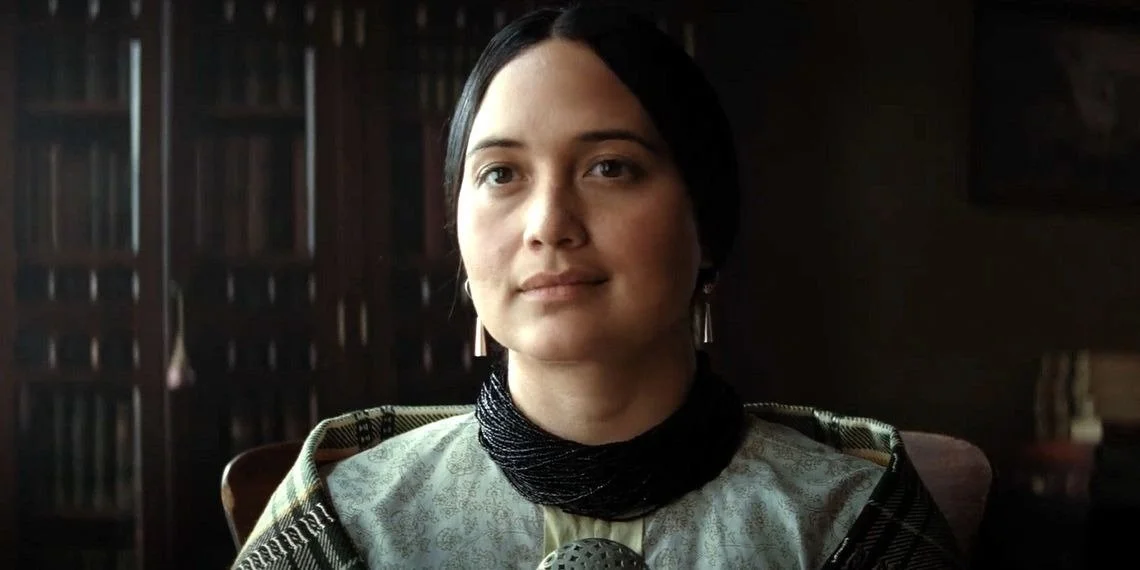
Lily Gladstone in Killers of the Flower Moon. Photograph by Apple TV+.
But what is it about the final list of nominations for Best Actress that has caused such a stir?
A common comparison between Gladstone’s nomination has been associated with the amount of screentime attributed to her role, suggesting that she would be better suited to a Best Supporting Actress nomination.
This criticism negates the fact that Gladstone is not playing a work of fiction but is in fact embodying a real figure, one integral to the history told in Killers of the Flower Moon. With 56 minutes of screen time in a film with a runtime of 3 hours and 26 minutes, notable actors and actresses over the decades have gone on to win Oscars for far less.
Sir Anthony Hopkins went on to win Best Actor for his role as famed antagonist Hannibal Lecter in Jonathan Demme’s Silence of the Lambs with less than 15 minutes of screentime in 1992. Most famously, Beatrice Straight won an Oscar for Best Supporting Actress in 1977 with only 5 minutes of screen time for her role as Louise Schumacher in Sidney Lumet’s The Network.
There's clear recognition for the women who contributed to transforming Barbie from a conventional girls toy into a complex and colourful world. Greta Gerwig, America Ferrera, Sarah Greenwood and Jacqueline Durran were all acknowledged and nominated for their respective parts in bringing Barbie world to life. Whilst Margot Robbie was not nominated for Best Actress, she was nominated for Best Picture for her part in building and creating the movie from the ground up.
Is it fair to brand Margot Robbie’s omission as a loss for feminism?
At the 45th Academy Awards in 1973, Sacheen Littlefeather, a Native American actress and activist, delivered a poignant speech on behalf of actor Marlon Brando, who boycotted the Best Actor award for his role in The Godfather. Brando's protest was rooted in the film industry's portrayal of Native Americans and served as a symbolic stand against the ongoing Wounded Knee siege.
Despite initial plans for a more extensive speech consisting of 739 words - producer, Howard. H Koch ordered for Littlefeather to be forcibly removed from stage and arrested should her speech exceed 60 seconds.
Littlefeather reads: “That he [Brando] very regretfully cannot accept this very generous award. And the reasons for this being are the treatment of American Indians today by the film industry.”
During the speech, Littlefeather maintained her calm conjecture in the midst of a charged atmosphere. She was met with an array of mixed reactions from the audience including boos, hollers, and applause.
Littlefeather went on to say; “I beg at this time I have not intruded upon your evening and that we will, in future, our hearts and our understandings will meet with love and generosity.”
In a subsequent interview in 2022 with Variety, Littlefeather revealed the backstage tension, mentioning that armed guards escorted her offstage to prevent interference from American actor and enduring symbol of Western movies, John Wayne.
Wayne was held back by six security guards in the wings. This incident, however, led to her alleged blacklisting from Hollywood, though she continued her commitment to First Nations activism until her passing from breast cancer in October 2022.
Whilst there has been some significant discourse surrounding Sacheen Littlefeather’s true identity in recent years, I feel the response to her presence and statement still speaks volumes about the academy’s treatment and views towards Native Americans at that time.
Fast forward 51 long, arduous years to 2024 - Gladstone’s pivotal contribution to the movie Killers of the Flower Moon did not go unnoticed by the academy, hailing her as the first Native American woman to be nominated for the Best Actress award in Oscars history.
We are fortunate enough to live in a society in which we get to witness history being made time and time again. History is and will still continue to be made at large scale awards ceremonies. Margot Robbie and Greta Gerwig being ‘snubbed’ in their respective categories is not a loss for feminism.
Whilst recognizing achievements and debating award nominations are essential aspects of cinematic discussions, the heart of the matter lies in celebrating the diversity of women's experiences. Whether that be through groundbreaking roles, directorial ventures, or transformative narratives like Barbie. As we witness history being made through awards ceremonies, let us not lose sight of the broader message imparted by films like Barbie – the importance of celebrating women from all walks of life and backgrounds. The true essence of feminism lies in unity, recognizing the achievements of every woman without diminishing the significance of one over another.
As we navigate the nuanced landscapes of cinema and societal progress, let us embrace the multiplicity of voices, stories, and talents. In doing so, we contribute to an inclusive narrative that mirrors the richness of the world we inhabit. In this era of groundbreaking cinematic achievements, it is not about choosing between Lily Gladstone and Margot Robbie; it is about honouring the diverse tapestry of women in an industry known for its exclusion.