Petals and Patriarchy: examining feminism and existentialism in Daisies
by Jordyn Kelsey
@jordynkelseymedia
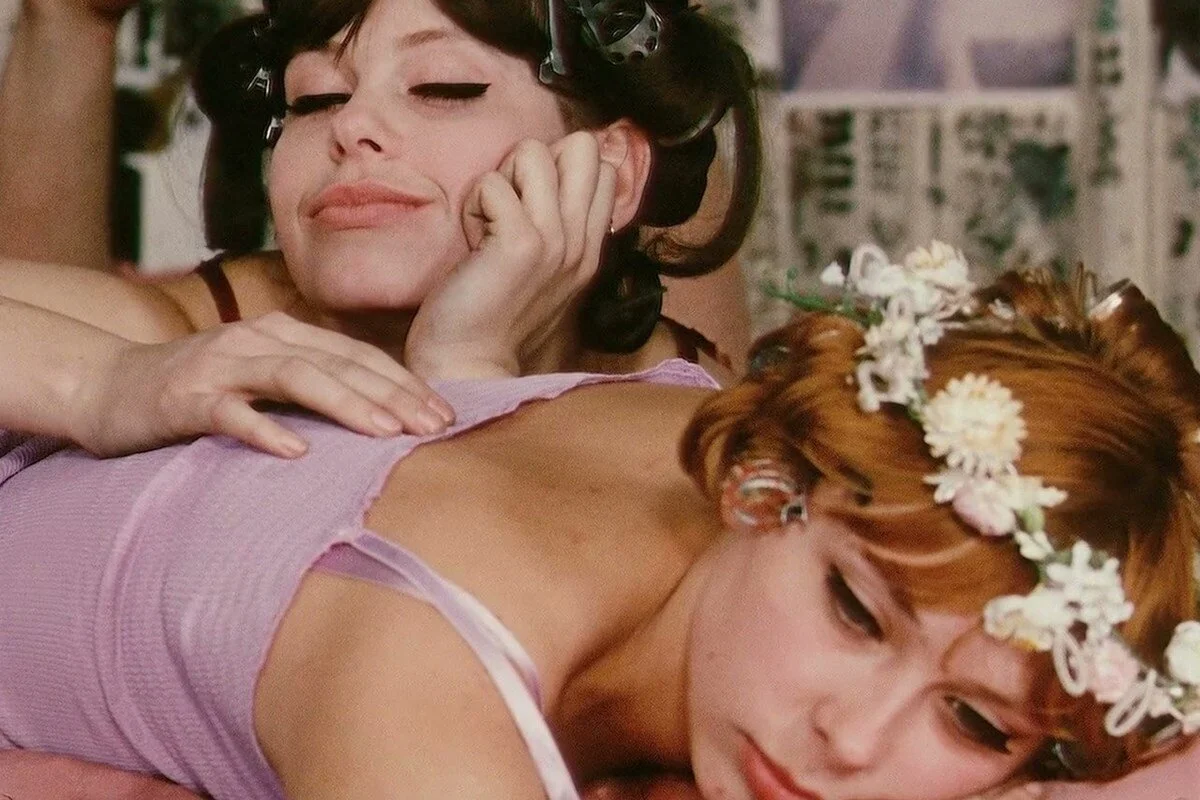
In 1966 Vera Chytilova’s classic film, ‘Daisies’ was released. An absurdist, 74-minute, hyper-feminist visual spectacle that explores themes of nihilism, politics, and sexuality, ‘Daisies’ has stood the test of time as a critique of being female in a male-dominated world, while also forcing the viewer to question the meaning of life.
The film follows two main protagonists, both named Marie, as they attempt to navigate an increasingly oppressive society. After declaring that “everything’s going bad in this world,” the two girls decide that they will ‘go bad’ and proceed to embark on a series of anarchic, destructive behaviours as an act of rebellion.
In 2024, ‘Daisies’ is all the more relevant. With the rise of social media, a new attitude towards feminism has surfaced. Now, women are working to reclaim stereotypes from girlhood to dismantle the long-standing belief that being overtly feminine equates to weakness and a lack of intelligence.
‘Daisies,’ achieved this in 1966. One example of this can be seen through the use of costumes. For example, the film opens with the two girls dressed in patterned bikinis and flower crowns, a move that could be argued as an act to sexualise them. However, if we consider the girl’s rebellious attitudes and the dialogue taking place, it is clear that the role of the costume in this context is to reflect the girls’ refusal to conform to the feminine ideals of 1960s Czechoslovakia.
As the girls progress through their journey of destruction and chaos, they spend the majority of the film wearing brightly coloured babydoll dresses. The babydoll silhouette started to gain popularity in the 60s and represented a rejection of what was deemed “appropriate” for women to wear, further reinforcing the Maries determination to dismantle traditional femininity.
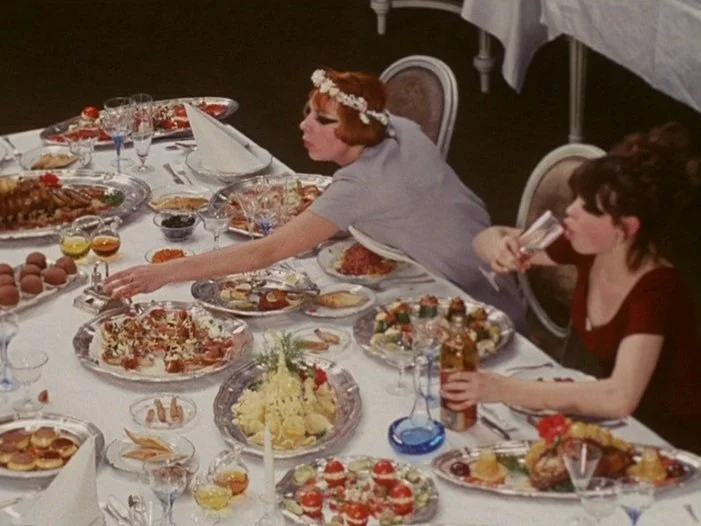
The final sequence of the film comes after the pair indulge in a massive feast. After eating enough food for a large party, they begin throwing the food at each other, dancing on the tabletop, and swinging from chandeliers.
In true surrealist fashion, the girls are suddenly plunged from the chandelier into a lake. While calling for help they realise that they are in this position because of their behaviour, declaring themselves “spoiled” and stating that they “don’t want to be spoiled anymore.”
As a result of this, the viewer is shown a parallel world in which the girls are given a chance to rectify the damages they caused. During this sequence, they are dressed in full-body suits made of newspaper. This transition from their preferred hyper feminine babydoll dresses to being more covered and conservative symbolises the attitude that for a woman to be a well-behaved and accepted member of society, she should keep her body covered. The girls decided at this point to conform to society's standards of modesty, in the hopes that it would make their life mean something.
However, once they have finished cleaning up, the girls state with uncertainty that they are happy but conclude that their happiness doesn’t matter. They are then immediately crushed by a falling chandelier, emphasising the lack of meaning in their lives as they have seemingly reached happiness only to die immediately after. This is a striking message from Chytilova, suggesting that even when women present themselves in a way that is ‘respectable’ and dignified without complaining, we still fall victim to a patriarchal society.
This ending also contributes to the overall nihilistic tone of the film. The term ‘nihilism’ originates from the Latin word ‘nihil’ that translates to nothing. It is a philosophical belief that denies any purpose in life. The existential nihilism present in ‘Daisies,’ argues that life is without value and meaning.
The Maries spend the duration of the film questioning the meaning of their life, from questions like “Who tells you…that you actually exist,” and “Does it matter?” to gleefully stating “We exist! We exist!” and concluding that “nothing matters.”
This nihilistic tone is in itself a feminist statement. Throughout media history, women have been stereotypically shown to primarily engage in discussions about superficial topics such as men, relationships, fashion, and beauty. The Maries challenge this representation by having these discussions and acknowledging deeper philosophical arguments. This reinforces the argument that despite the girls’ decision to present themselves as overtly feminine through their clothing and sexuality, they still possess a level of self-awareness and intelligence that is often disregarded by men because of their appearance. Essentially, the nihilistic theme of ‘Daisies,’ serves as a radically feminist statement that celebrates female autonomy and complexity while challenging the idea that femininity and intelligence are mutually exclusive.
‘Daisies,’ stands the test of time as a crucial piece of feminist cinema, not only for the bravery displayed by Chytilova through her bold criticism of the communist government in place at the time, but for her unique representation of femininity and destruction.
In a world where discourse around feminism continues to blossom, the film is all the more relevant, resonating with a whole new generation of women who seek to reclaim aspects of femininity that were previously looked down upon.