The roles we play in love: On the “Before” Trilogy
by Ruby Skippings
@rubyskips
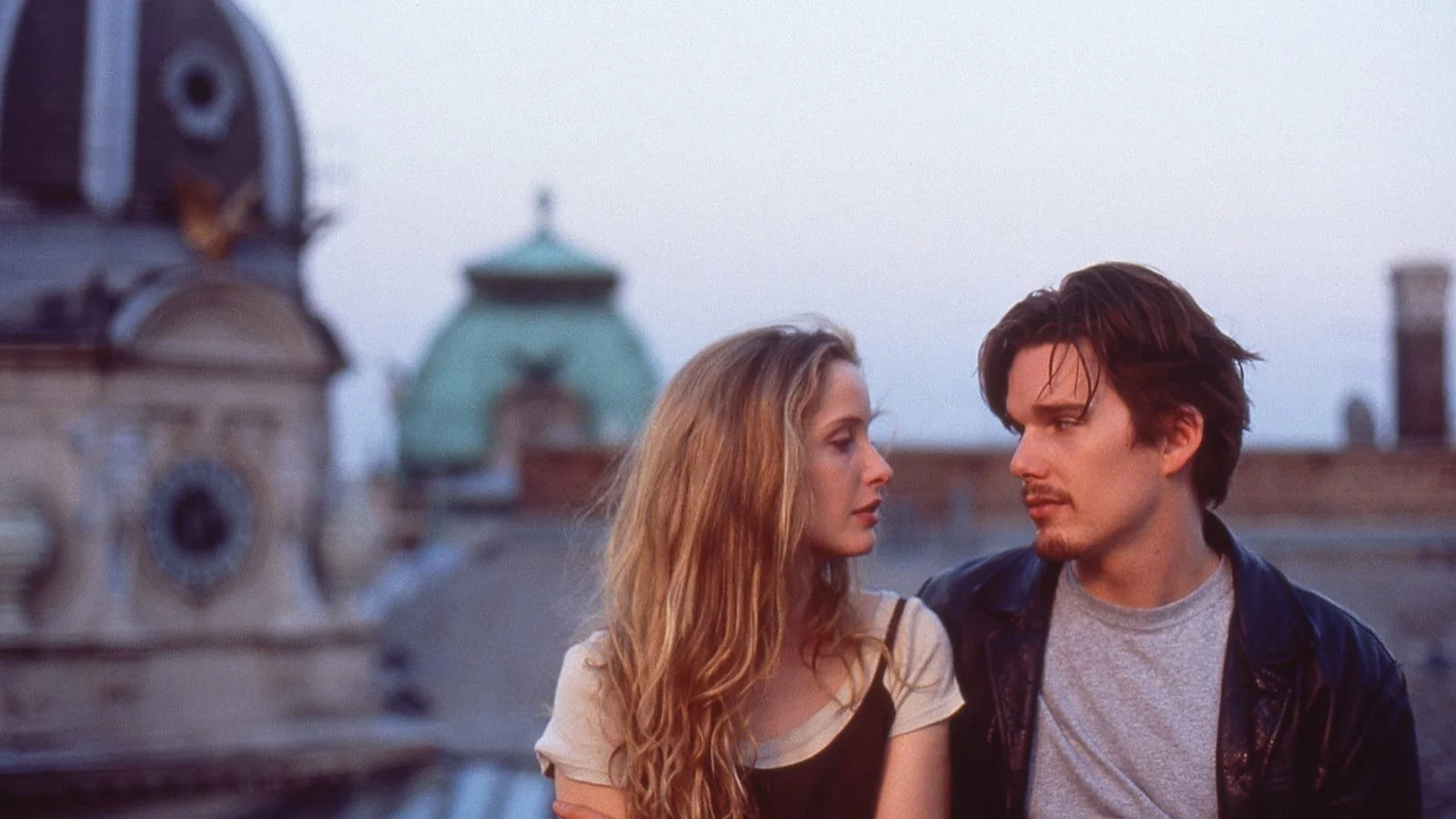
Richard Linklater gives us a masterclass in depicting a real relationship, but his character’s strong alliance with hetero gender norms feels outdated.
The 1995 film “Before Sunrise” was meant to be a one-off indie film based on director Linklater’s chance encounter with a woman over the course of a single night. The film’s massive success saw not one but two more films made, and so a three-act, decade-spanning series was born, following the changing relationship between Jesse (Ethan Hawke) and Celine (Julie Deply). Rarely has a genuine connection been so well depicted on screen, which makes it all the more devastating as we watch that connection become strained in the vulnerable final instalment, “Before Midnight”. It’s vital for audiences to see that these are real people, riddled with flaws that cause fundamental differences. But watching the films back, their differences almost completely align with stereotypes about men and women that have been perpetuated in the media for generations.
Anyone who’s been in or around a couple who have been together for a while knows that things aren’t always smooth sailing. So it comes as no surprise, really, that Celine and Jesse spend most of “Before Midnight” arguing - prompted by Jesse’s desire to move back to America to be near his son - when previously it was all puppy-love prose and stolen glances. Celine, a fiercely independent activist and personal hero of mine, is (rightfully) worried the move will cost her her career, which Jesse can’t (or won’t) understand. What ensues is a series of snide comments, comparison to other couples and confessions of doubting whether the marriage still has love in it. It turns out this isn’t the case, but middle-aged regret has taken its toll. In a very human twist, Celine and Jesse have reached their happy ending whilst still wondering “What could have been?”.
The roles that Celine and Jesse play are often frustratingly predictable for a straight couple. The films are pretty much exclusively dialogue, and most of it is said by Celine. She’s opinionated, feisty and stands her ground when it comes to injustice. Jesse, on the other hand, is passive and cracks a lot of jokes. He finds Celine’s passion somewhat amusing and winds her up about it. This kind of dynamic is constantly shown on screen: the calm and collected boy is enamoured by the know-it-all feminist girl. It could even be argued Celine is a borderline Manic Pixie Dream Girl, without the troubled past and dyed hair. It’s kind of fascinating how much this female character trope defined the 90s and 2000s. Apparently it was impossible to make a woman desirable without her being kooky and “not like other girls” (and at the same time, incredibly sexy). There’s a lingering sense that Celine is too harsh on Jesse, who’s just trying to have a good time, when in actuality he mocks the genuine feelings Celine is having. It’s tiring to watch, and takes away from the incredible writing in the rest of the script.
We don’t see much of Jesse and Celine parenting their 9-year-old twin girls in “Before Midnight”, but I wouldn’t be surprised if this dynamic seeped into their parenting techniques. Most likely, Jesse gets to be the good cop while Celine has to bring everyone back down to earth. You don’t have to look far to find this trope elsewhere in Film and TV - Modern Family did it for 11 seasons. Stereotypical French woman and American man, you could argue. As they spend a night fighting in their hotel room, their inability to see eye-to-eye is simultaneously gut-wrenching and formulaic.
In my opinion, the best film of the franchise is the magnetic middle instalment, “Before Sunset”. Just as a side note, the symbolism of the titles is a stroke of genius. Obviously, they all refer to periods of cosmic shift. The spiritual significance of these times has been passed down through generations of folklore, and we’re all aware of them. “Before Sunrise” insinuates a relatable feeling: experiencing something so intense during the dead of night that you don’t want the next day to begin. After all, everything is heightened at night, from fear of the dark to Jesse and Celine’s powerful love-at-first-sight encounter. “Before Midnight” reminds me of Cinderella’s curse, her desperation to meet the Prince before she turns back into a pumpkin. Maybe their ability to laugh together is their glass slipper: a lifeline that can bring the couple together again.
But “Before Sunset” implies a lost chance, the sense of a missed opportunity as the sky fades into hues of orange and magenta. It’s what almost happens in this film. 9 years on from their meeting (and 9 years later in real-time as well), Jesse is touring with his book, which Celine discovers rings true to the night they spent together almost a decade ago. After coming to the bookshop where he’s doing a Q&A, she shows him around Paris as they catch up about life since they parted ways at the Austrian train station. It turns out Jesse came back for her, and their decision to not exchange contact details grows more devastating as the film goes on. They’d lived in New York around the same time but just missed each other. Now Jesse’s unhappily married and Celine can’t shake the feeling that she has no capacity for love since him. Their respective situations aren’t unheard of - man trapped by a woman he doesn’t love, woman unable to be tied down until him - but they have elements which are raw and real and relatable.
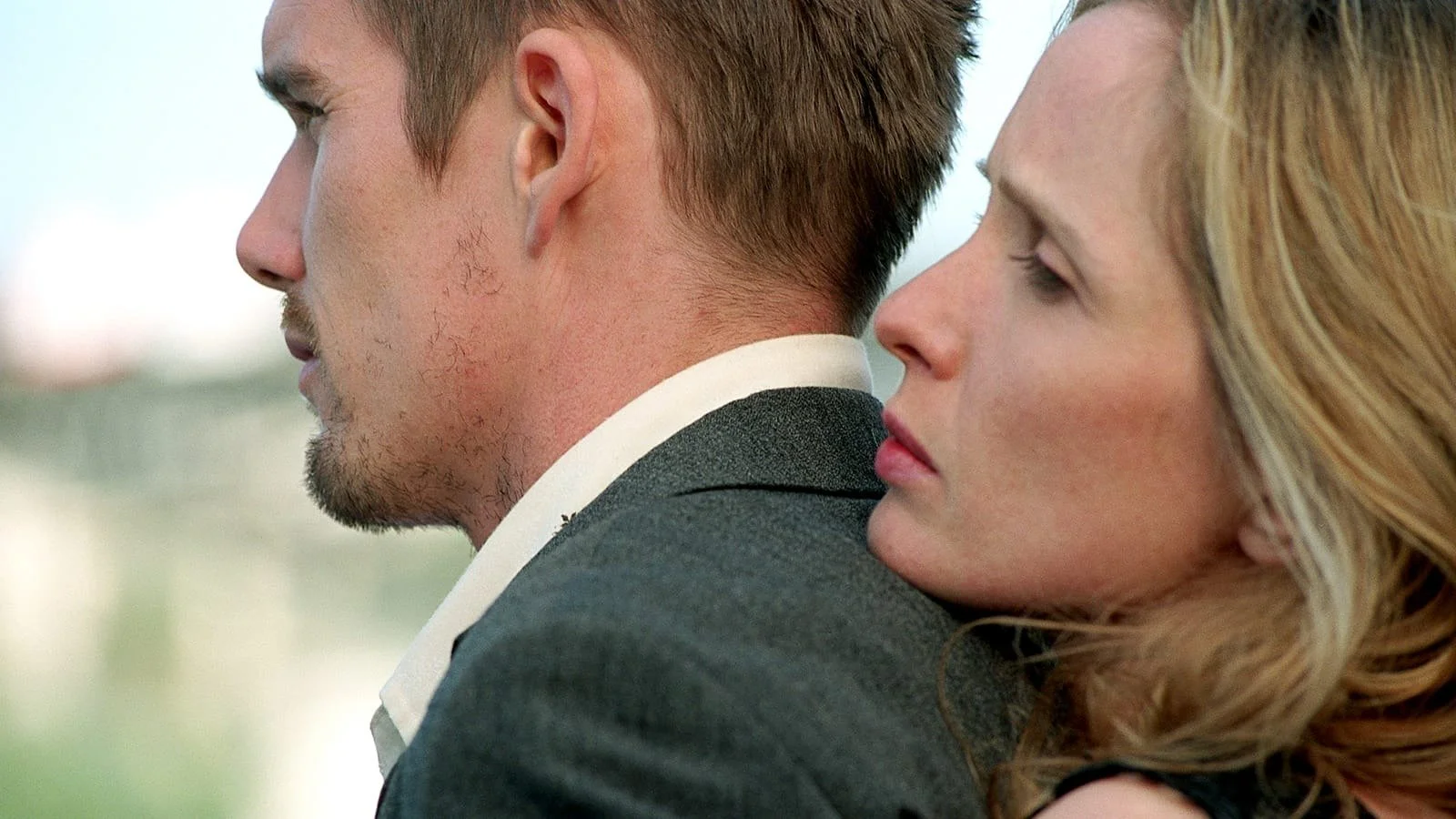
Another standout feature of “Before Sunset” is its ending, when the sun is about to go down. Celine jokes that Jesse is going to miss his plane home, and the last line is his simple response: “I know”. It would’ve been perfectly adequate to leave these characters here, with the audience knowing that Jesse stayed in that flat, staring lovingly at Celine. But Linklater, Delphy and Hawke wanted to explore who these people are as a fully-fledged married couple. In “Before Midnight”, we see the couple in their most nuanced form, even though their character traits are sometimes stuck in 2D. In later interviews, the collaborators revealed that they wanted Celine and Jesse to mirror the argumentative older couple on the train when they first met. Is it every couple’s fate, to become an older, less happy version of themselves? Yes, the creators argue, to an extent, but the bickering pair have a recognisable fondness and respect for each other that Celine and Jesse have grown into. The “I hate my significant other” trope is seen too often in portrayals of straight relationships, yet I don’t think the “Before Midnight” is entirely guilty. Things change with time, and not always for the better.
Is “Before Midnight” as much fun to watch as “Before Sunrise”? No, no it isn’t. But that’s because these characters had to grow up - they can’t be 23 forever. In the first film, Celine and Jesse randomly meet on the train, and have their whole lives ahead of them. They chat about philosophy and the future as they wander around Vienna, sharing a shy first kiss and making love in a park. We fall for the overly serious Celine and the carefree Jesse, even though the continuation of these personality traits makes the later films slightly painful. They’re young, flirty, carefree, unburdened by children or elderly parents or any kind of real responsibility. And what kind of fun would it be for the creators to just keep making the same film again and again? I don’t think anyone would believe that 41-year-old Jesse and Celine are just as drunkenly in love as their first encounter, still giggling and chasing each other through streets. Not only would this be semi-ridiculous to watch, it would be inauthentic to a film franchise which so heavily relies on authenticity. So their relationship has to change. The 2013 film is less brimming with sexual tension, sure, but it’s also more stable, held up by the quiet knowledge that they truly know one another. And that’s one of the most beautiful things about love - the fact that it slows down.

A spoiler alert: in the final scene of “Before Midnight”, at a late-night dinner, the couple reconcile after a shared joke about this potentially being one of the best nights of their life. I mean, on many counts, it could be: they’re sitting at a seafront restaurant in Greece, drinking wine, relaxing in the warmth of a summer evening. And yet, the atmosphere isn’t relaxed. Outside of their constant bickering, the colour-grading works to heighten the tension. Obviously when filming in Greece, it’s going to be sunny, but the film is almost uncomfortably bright, forcing the actors to squint as they’re walking around. We get the sense that everything is being exposed, laid out for display. As well as this, the contrasting colour palette of exclusively white and blue is unavoidable, much like the couple’s opinions on their future. The previous two films had softer tones of yellow, green and brown, reflecting Jesse and Celine’s softer, more forgiving attitudes to the world and each other. This in itself is an ode to the different stages of their relationship - it’s more colourful, but the cracks are glaringly obvious.
As the audience, we breathe a small sigh of relief as the film ends on a positive note. The force that brought Jesse and Celine together - the fact they genuinely like being around one another - is still there. But nothing is perfect, and we’re meant to experience a lingering feeling that there are more bumps in the road in store for this couple. Love is uglier than romance, but at the end of the day, there’s no comparison, and “Before Midnight” masterfully depicts Celine and Jesse’s love as one that’s built to weather the storms. None of the “Before” films think outside the box too much in terms of developing its individual characters, but maybe that’s because we’re meant to see them as a couple through-and-through - an inseparable unit.
By Ruby Skippings